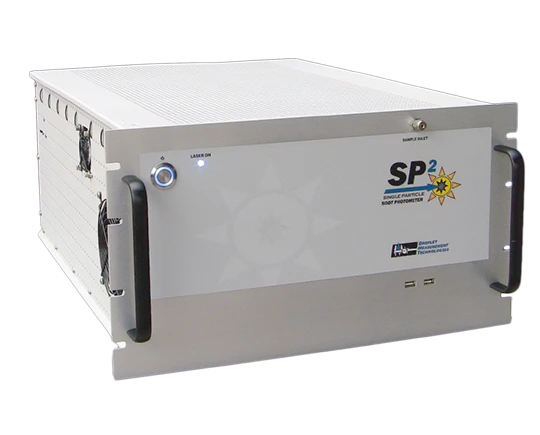
Single Particle Soot Photometer (SP2)
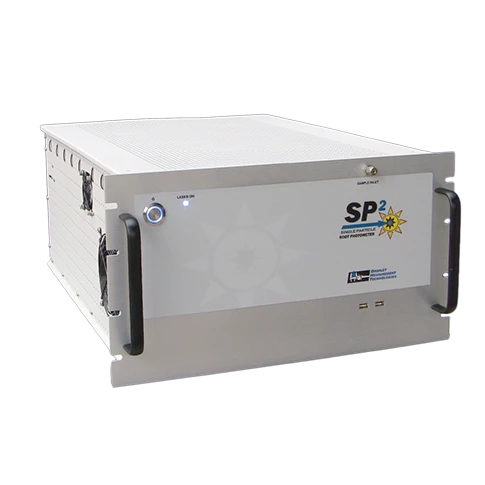
The SP2 is Droplet’s premier instrument for direct measurement of black carbon in individual aerosol particles. The SP2 delivers unmatched detail about black carbon particles, including mass, size, heat of vaporization, and coating – critical information for characterization of pollution sources, accurate description of optical properties, and prediction of health effects.


Product Description The Single Particle Soot Photometer (SP2) is the only instrument in the world that directly measures the black carbon (soot) in individual aerosol particles. Its high sensitivity, fast response, and specificity to elemental carbon make it the premier instrument for characterizing air pollution sources and documenting thin, atmospheric layers of contamination. It is also ideal for measuring soot in snow, ice or water and for calibrating other black carbon-measuring instruments like the Aethalometer.

 Advantage Characteristics  Technical Parameter  Application Scope  Classic Cases
Advantage Characteristics
Measures particle optical size using light scattering Counts particles at concentrations up to 16,000 particles/sec (8,000 particles/cm3 at a sample flow rate of 120 volumetric cm3 /minute) Detects black carbon mass at minute concentrations (below 10 ng/m3 )
Measures black carbon (soot) mass in individual aerosol particles Uses Nd:YAG intracavity laser-induced particle incandescence (LII), a technique that measures black carbon mass independently of particle mixing state and hence yields more accurate results Provides full data recording of each particle event
Technical Parameter
  • Measured Parameters Single-particle laser incandescence Single-particle light scattering
  • Auxiliary Parameters Temperature Pressure
  • Derived Parameters BC mass distribution as function of particle diameter Particle number distribution as a function of particle size
  • Maximum Data Acquisition Rate 0 – 12,500 particles/cm3 at 120 vccm (0 - 25,000 particles/sec; concentrations can basically increase until particles become coincident)
  • Particle Size Range Scattering signal: 200 – 430 nm diameter (this range encompasses the accumulation mode of most particles, i.e. range where most mass is found). Incandescent signal: depends on particle density, but 70 – 500 nm mass-equivalent diameter assuming a black carbon density of 1.8 g/cm3
  • Aerosol Medium Air, 0 - 40 °C (32 - 104 °F)
  • Lasers Nd:YAG Laser: 1064 nm, 3 MW/cm2 intracavity circulating power Pump Laser: 808 nm, 4 W
  • Sample Flow 30 – 180 volumetric cm3/minute (typically 120)
  • Flow Control Electronic flow control with a laminar flow element (LFE) and a solenoid valve
  • Pump Two single-head diaphragm pumps encased in a box
  • Minimum Black Carbon Detection Limit 10 ng/m3 0.3 fg/particle
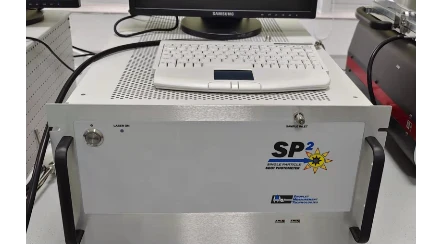
  • Front Panel Display System power switch; 2 USB 2.0 ports ;1/8 in. Swagelok® sample inlet ;Laser ON/OFF indicator light
  • Rear Panel Connections Keyboard port; Mouse port; VGA and HDMI monitor ports; Ethernet port; 2 RS-232 communications ports; 4 USB 2.0 ports; eSATA port ;¼ in. Swagelok® purge line; ¼ in. Swagelok® exhaust line; Exhaust vents; System and pump power connections
  • Computer System On-board Intel®Core™ i7 CPU;8 GB RAM;750 GB hard drive for data storage;NI PCI-6133 DAQ interface card;NI PCI-6259 housekeeping data card;User interface via standard keyboard, mouse, and 19” monitor (included)
  • Data Storage Capacity Depends on number of particles; at a concentration of 1,000 #/cm3 and a standard flow rate of 120 volumetric cm3 /minute, the SP2 computer has the capacity to store 56 hours of continuous data
  • Communications Output Gigabyte Ethernet interfaced through an Intel® PC82573V PCIe GbE controller
  • Power Requirements SP2: Universal Voltage External Pump: 30 W
  • Dimensions SP2: 48 cm W x 61 cm L x 26 cm H Pump: 20 cm W x 25 cm L x 10 cm H 19
  • Weight SP2: 26.1 kg Pump: 3.4 kg 19
  • Environmental Operating Conditions Temperature: 0 – 40°C (32 – 104 °F) RH: 0 – 100% RH non-condensing
Application Scope
Pollution characterization
Air quality and visibility
Atmospheric and climate research
Health effects studies
Combustion emissions
Biomass burning
Hangzhou Shallow-Sea Technology Co., LTD.
Hangzhou Shallow-Sea Technology Co., LTD. WeChat
Contact
Hangzhou Shallow-Sea Technology Co., LTD.T1-11F, Herui Science and Technology Park, Binjiang District, Hangzhou City, Zhejiang Province
© Hangzhou Shallow-Sea Technology Co., LTD. 浙ICP备17036607号-2 浙公网安备33010802011794号 Site Map
Hangzhou Shallow-Sea Technology Co., LTD.Hangzhou Shallow-Sea Technology Co., LTD.
Phone
86-0571-81956003
Hangzhou Shallow-Sea Technology Co., LTD.Hangzhou Shallow-Sea Technology Co., LTD.
WeChat
Hangzhou Shallow-Sea Technology Co., LTD.
Hangzhou Shallow-Sea Technology Co., LTD.Hangzhou Shallow-Sea Technology Co., LTD.
Message
Hangzhou Shallow-Sea Technology Co., LTD.